
A356 / A356-T6 squeeze casting
Aluminum poured at low velocity and solidified under pressure, then T6 heat treated and machined in-house. For parts that must hold pressure, carry load or be welded, where a die casting has failed or a forging costs too much to machine.
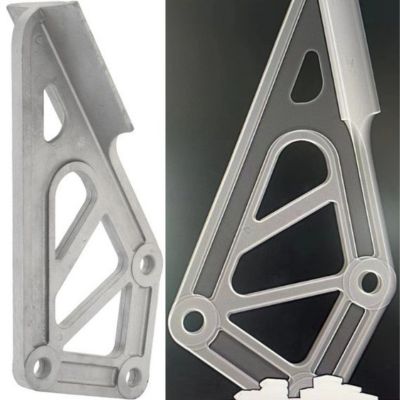
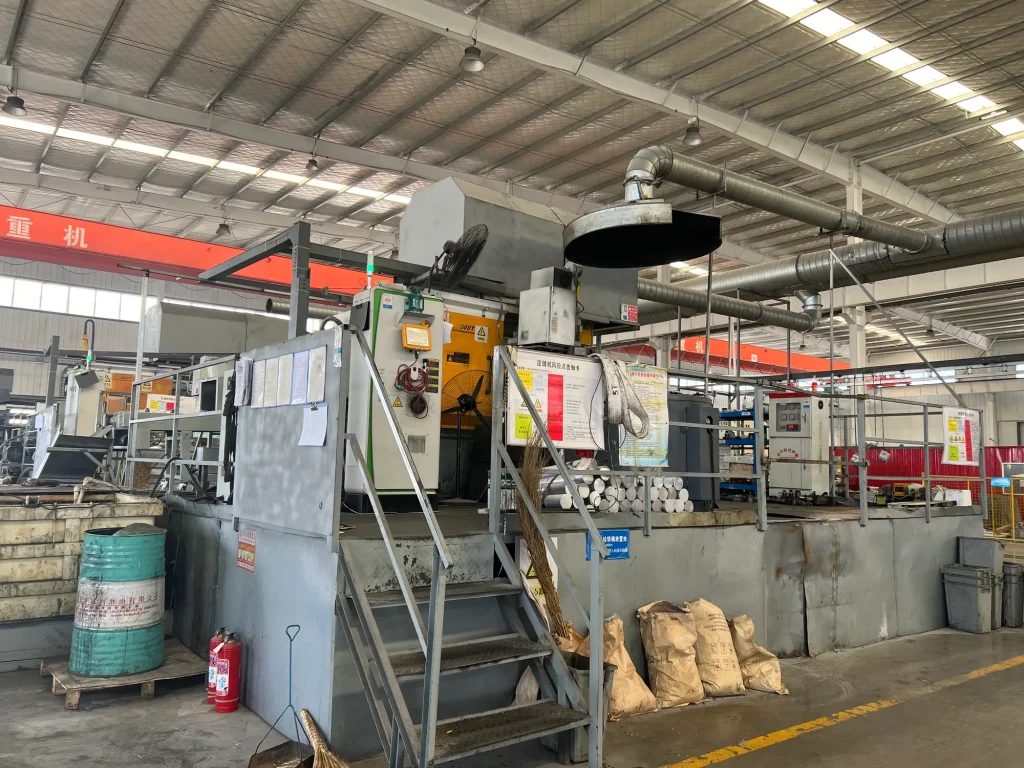
Capability envelope
Use the table to screen a part before sending it. The limits are not all reachable on one geometry at once; projected area, wall section, alloy and the soundness required decide what a given press can make.
Parts too heavy for our largest press, or outside a die envelope of about 1.2 × 0.8 m, are outside the range normally quoted. Send the drawing anyway and the answer will say so in writing.
| Parameter | Published range |
|---|---|
| Squeeze casting presses | 300–1,100 t |
| Alloys listed for squeeze casting | A356 / A356.2, A380, A383, AlSi9Mg, AlSi10Mg, AlSi9Cu3 |
| Part weight | Reviewed per drawing against press size |
| Part envelope | Up to 1.2 × 0.8 m |
| Wall thickness | 4–15 mm |
| As-cast blank tolerance | ±0.2 mm; machined tolerances agreed per feature |
| Heat treatment | T6 in-house, scheduled with the machining sequence |
| Number of squeeze presses | Part of our 7 aluminum casting machines, 300–1,100 t |
A356 and A356.2: composition
A356 is an aluminium–silicon–magnesium casting alloy, AlSi7Mg0.3 in European practice. Silicon near 7% gives the fluidity to fill a complex die under pressure; magnesium makes the alloy respond to T6. Copper is held to 0.2% or less, which keeps corrosion behaviour good when the casting is bolted to a dissimilar metal.
A356.2 is a variant with a tighter composition window. Published A356.2-T6 tensile and yield values can sit slightly above A356-T6, so the two are not interchangeable without checking the drawing. Name the one you need and the standard that governs it.
| Element | A356 (%) | A356.2 (%) |
|---|---|---|
| Silicon (Si) | 6.5–7.5 | Tighter window than A356; limits per the ingot standard named in the order |
| Magnesium (Mg) | 0.20–0.45 | |
| Iron (Fe) | ≤ 0.2 | |
| Copper (Cu) | ≤ 0.2 | |
| Manganese (Mn) | ≤ 0.1 | |
| Zinc (Zn) | ≤ 0.1 | |
| Titanium (Ti) | ≤ 0.2 | |
| Aluminium (Al) | Balance (91.1–93.3) |
A356 and A356-T6 properties, and how to specify them
The published figures support a first feasibility discussion. They are not acceptance criteria for an unreviewed part. The order specification needs agreed minimums, the specimen location and the test method.
| Property | A356, published range across tempers | A356-T6 squeeze cast, published reference | What to state on the drawing |
|---|---|---|---|
| Tensile strength | 207–310 MPa | 260–320 MPa | Minimum value, test standard, specimen from the part or separately cast |
| Yield strength (0.2%) | 138–228 MPa | 220–260 MPa | Minimum value on the same specimen basis |
| Elongation | 3–10% | Not yet published | Minimum value and gauge length; the property most sensitive to porosity in the specimen zone |
| Hardness | 70–80 HB | Not yet published | Range and location, checked after heat treatment |
| Density | 2.68 g/cm³ | Same alloy | Used for weight estimates, not acceptance |
| Melting range | 570–580 °C | Same alloy | — |
| Thermal conductivity / expansion | 151 W/m·K · 21.4×10⁻⁶/°C | Same alloy | State if the part is a heat path or mates with steel |
| Basis of the figures | Reference ranges; measured data set in preparation | Sampling per lot or per heat-treat batch | |
Drawing note to adapt
MATERIAL: A356.2 to [standard], heat treated to T6.
MECHANICAL: UTS ≥ ___ MPa, YS ≥ ___ MPa, elongation ≥ ___ % on specimens taken from zone ___, tested to [method]. One test set per heat-treat batch.
SOUNDNESS: X-ray of zones ___ to [reference standard and level]. No repair welding or impregnation without written approval.
LEAK (if sealed): [medium] at ___ bar, allowable leak rate ___ [unit], after final machining.
Blanks are deliberate: the values come from your design authority, not from a supplier's brochure.
Direct vs indirect squeeze casting
The difference is not the alloy or the die steel. It is where the pressure is applied and how the metal reaches the cavity. Direct suits large, flat, thick parts; indirect reaches thinner walls and more complex geometry.
| Aspect | Direct squeeze casting | Indirect squeeze casting |
|---|---|---|
| How metal enters | Poured into a preheated open die; the punch closes and presses the melt directly | A ram pushes melt from a separate pressure chamber through a runner into the cavity |
| Fill turbulence and air entrapment | Higher: melt is poured into an open die | Lower: melt is pushed through a controlled channel |
| Pressure distribution | Concentrated where the punch acts | Applied uniformly across the cavity |
| Walls and geometry | Best on thick sections; large, flat parts where shrinkage and warping are the risk | Thin walls, internal features, fluid-control bodies, heat sinks |
| Tooling | Temperature-controlled die plus punch | Adds chamber, ram and runner system |
| Blank tolerance | ±0.2 mm on the blank | ±0.2 mm on the blank, tighter on machined features |
Neither route is the answer for a simple housing at high volume with no pressure-feeding requirement: that is a die casting.
When squeeze casting is the right comparison
The question is which property of the finished part decides the application, not which process name sounds stronger.
| Current or alternative route | Usually the better choice when | Squeeze casting is evaluated instead when |
|---|---|---|
| High-pressure die casting | Thin walls, fine detail, high volume, no internal-soundness requirement | A leak, a void opened by machining or a failed mechanical test cannot be solved on the existing route |
| Forging | Compact, simple parts that need worked material and high strength | Pockets, ribs and interfaces need extensive machining on the forged part |
| Sand or gravity casting | Prototypes, low volume, large simple parts with modest mechanical needs | Shrinkage rejects or excess section weight are why the part is being reviewed |
| Machining from solid | Prototypes, very low volume, tight tolerance over most surfaces | Most of the billet is turned into chips at production volume |
Published A356.2-T6 parts
Outcomes as reported by the original projects. Each new part needs its own drawing review and validation.
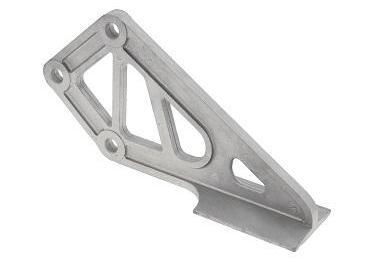
Trailer bracket
Weldable; about 50% higher strength and markedly higher production efficiency reported.
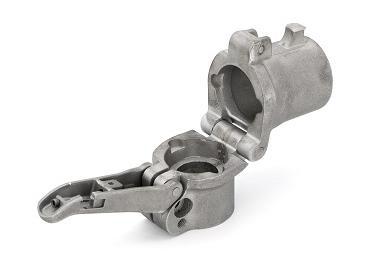
Scooter folding part
At least 40% cost saving reported, mainly from reduced downstream machining.
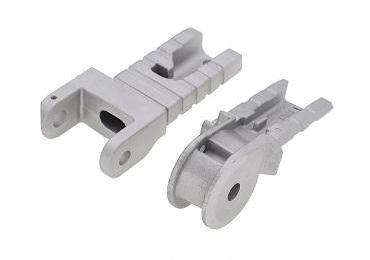
Tent folding part
About 50% higher strength reported against the die-cast original.
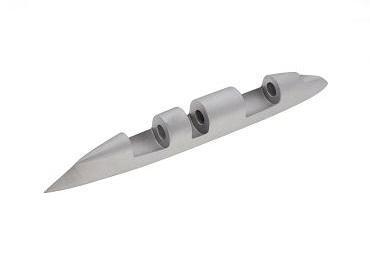
Boat part
At least 50% higher strength reported.
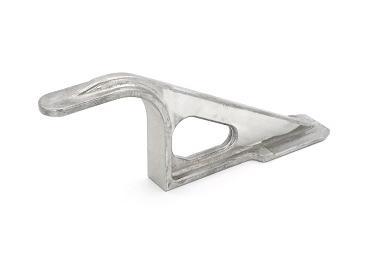
Support bracket
Shown on the current squeeze-casting page without project details.
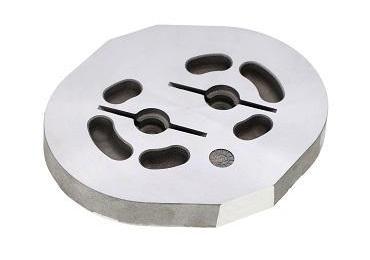
Structural part
Shown on the current squeeze-casting page without project details.
Three checks before you change process
Changing from forging
Compare finished geometry, load cases and test requirements. A tensile value alone does not show equivalent fatigue performance or assembly behaviour.
Changing from die casting
Name the actual rejection mode: a leak, a void exposed by machining, or a failed mechanical test. Judge squeeze-cast samples against the same acceptance criteria.
Specifying T6
Confirm the alloy designation and the property requirement, including where the specimen is taken. Plan machining and dimensional checks around the heat treatment.
Certificates that apply to this part
Certificates belong to the production entity, Qingdao Dechengxin Metal Products Co., Ltd., and to the sites listed on them. Read the scope literally.
| Standard | Number | Valid to |
|---|---|---|
| IATF 16949:2016 | 0494978 (NQA T182620) | 2027-01-07 |
| ISO 9001:2015 | 08924Q53221R1S | 2027-12-22 |
| IATF scope as printed: manufacturing of aluminium alloy die-cast parts, clause 8.3 product design excluded. Design inputs and drawing approval stay with the customer. | ||
Questions engineers ask
- Does squeeze casting guarantee zero porosity?
- No. No blanket defect-free guarantee is appropriate for any casting process. Agree the regions to inspect, the test sensitivity, the discontinuity limits and any leak-rate requirement for the actual part.
- Can a squeeze casting directly replace a forged or steel part?
- Only after design and material review. Compare stiffness, strength, durability, interfaces and operating conditions, and approve the replacement after the agreed component validation.
- Can squeeze castings be T6 heat treated?
- Suitable alloys such as A356 can be squeeze cast and T6 heat treated. The required properties must be agreed for the alloy, geometry and test method; they are not a blanket guarantee for every part.
- What is the difference between A356 and A356.2?
- A356.2 is a variant of A356 with a tighter composition window. Published A356.2-T6 tensile and yield values can sit slightly above A356-T6 depending on composition and processing, so name the one you need and the governing standard on the drawing.
- Direct or indirect squeeze casting: which does my part need?
- Direct squeeze casting suits large, flat or thick parts where shrinkage and warping are the main risk. Indirect squeeze casting, with a separate pressure chamber and runner, suits thin walls, internal features and parts that need uniform pressure. The drawing review decides.
- Which alloys can be squeeze cast?
- The published list is A356 / A356.2, A380, A383, AlSi9Mg, AlSi10Mg and AlSi9Cu3. Confirm the exact designation and standard in the inquiry; similarly named alloys in different systems are not interchangeable without review.
- Is there a minimum order quantity?
- There is no blanket minimum. The economic point depends on tooling amortisation and the process, so give the expected annual demand with the drawing and both the tooling cost and unit price can be compared at realistic volumes.
Send a part you want to convert
Send the drawing, the current process, the alloy and temper you need and the annual quantity. If the part was rejected on the current route, say how: leak, void after machining or failed test.
What happens next
- Howard Ding confirms receipt and asks for anything missing from the package.
- Engineering reviews geometry, alloy and acceptance criteria and proposes a route: squeeze casting, die casting, or a reason neither fits.
- You receive the quotation with tooling, samples and validation listed separately from the part price.