
Helium leak testing of aluminum castings
Helium sniffer testing in-house for castings that must hold a tight leak rate, alongside water immersion and pressure testing. Specify the method, pressure and reject rate, and we test to it.
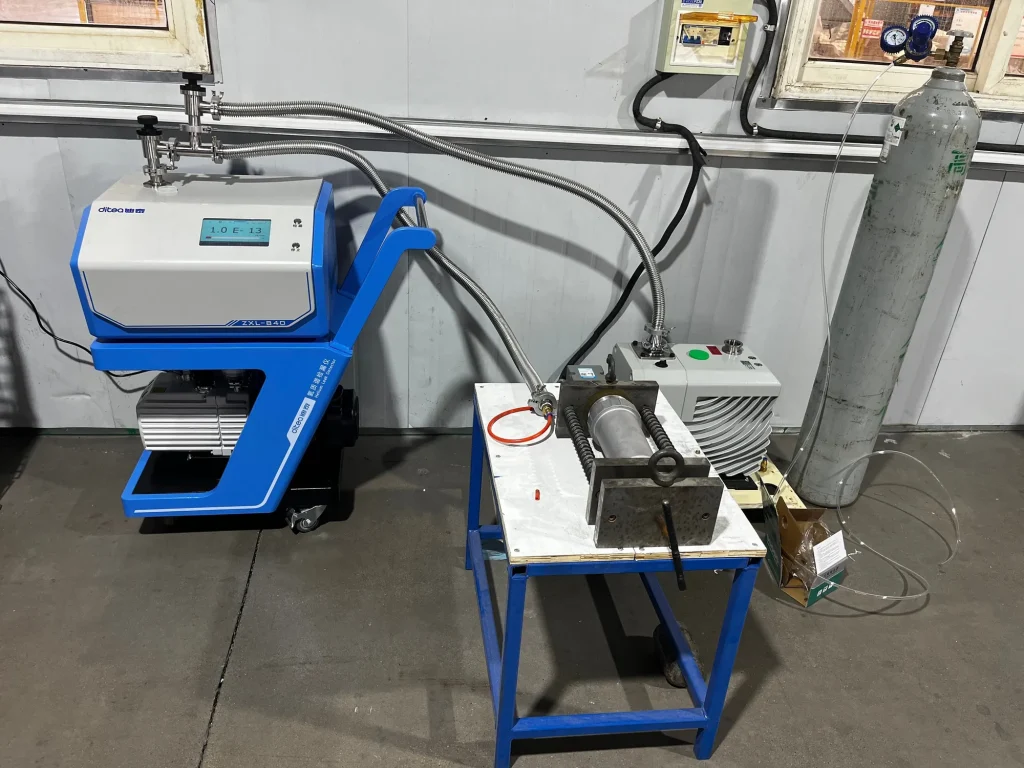
How helium leak testing of a casting works
The casting is sealed except for a test port and filled with helium at pressure. An operator draws a sniffer probe, connected to a mass spectrometer, slowly across the surface. Where helium escapes, the spectrometer registers it and the leak is pinpointed. Helium atoms are small enough to pass through paths that other gases cannot, so the test finds leaks far below the size that produces a visible bubble.
Sensitivity in sniffer mode depends on probe distance, sweep speed and the helium already in the room air, so we take a background reading before the part is charged and purge between parts.
- Part cleaned and dried: oil, swarf and moisture can plug a fine leak path
- Volumes not under test masked and sealed
- Background helium level measured before charging
- Machined sealing faces tested, because that is where the part is clamped in service
- Part purged after the test so residual helium does not affect the next reading
Helium vs pressure decay vs water immersion
Each leak test answers a different question. Specify the one that matches the leak rate your part needs.
| Helium, sniffer | Pressure decay | Water immersion (bubble) | |
|---|---|---|---|
| What it measures | Helium escaping at the probe, read by a mass spectrometer | Pressure drop over a fixed dwell | A visible stream of air bubbles |
| Sensitivity | Very small leaks, below the bubble threshold | Set by volume, temperature and dwell | Limited by what the eye can resolve |
| Locates the leak | Yes | No; says a part leaks, not where | Yes |
| Throughput | Slower; the surface is swept by hand | Fast pass/fail for volume | Fast once the fixture is repeatable |
| Best fit | Tight leak-rate requirements: gas valves, sealed housings | Batch testing to a maximum pressure drop | Coarse criterion, fast locate |
What leak rate to specify for a casting
Start from the failure the test is meant to prevent: the medium, operating pressure, temperature and how much escape the product can tolerate over its life. Do not copy a leak rate from an unrelated part. Then write the test, not just the number.
A statement that a part "held pressure" leaves the acceptance open. A helium result without units, pressure and method cannot be compared between suppliers.
| Field | Example of what to write |
|---|---|
| Method | Helium sniffer, or vacuum chamber (integral) |
| Test pressure | Value, unit, gauge or differential |
| Helium concentration | 100% or a stated mix |
| Reject leak rate | Value with units, e.g. mbar·l/s |
| Stage and boundary | After machining or as assembled; which ports are sealed |
| Sampling and record | 100% or a plan; part ID, result, operator, date |
Helium leak rate units
Leak rates are quoted in several units. Convert before comparing two specifications or two test reports.
| Unit | Equals |
|---|---|
| 1 mbar·l/s | 0.1 Pa·m³/s |
| 1 Pa·m³/s | 10 mbar·l/s |
| 1 mbar·l/s | ≈ 0.987 atm·cc/s (std cc/s) |
| 1 mbar·l/s | ≈ 59.2 sccm (at 0 °C) |
| 1 Torr·l/s | ≈ 1.333 mbar·l/s |
What the helium test report must state
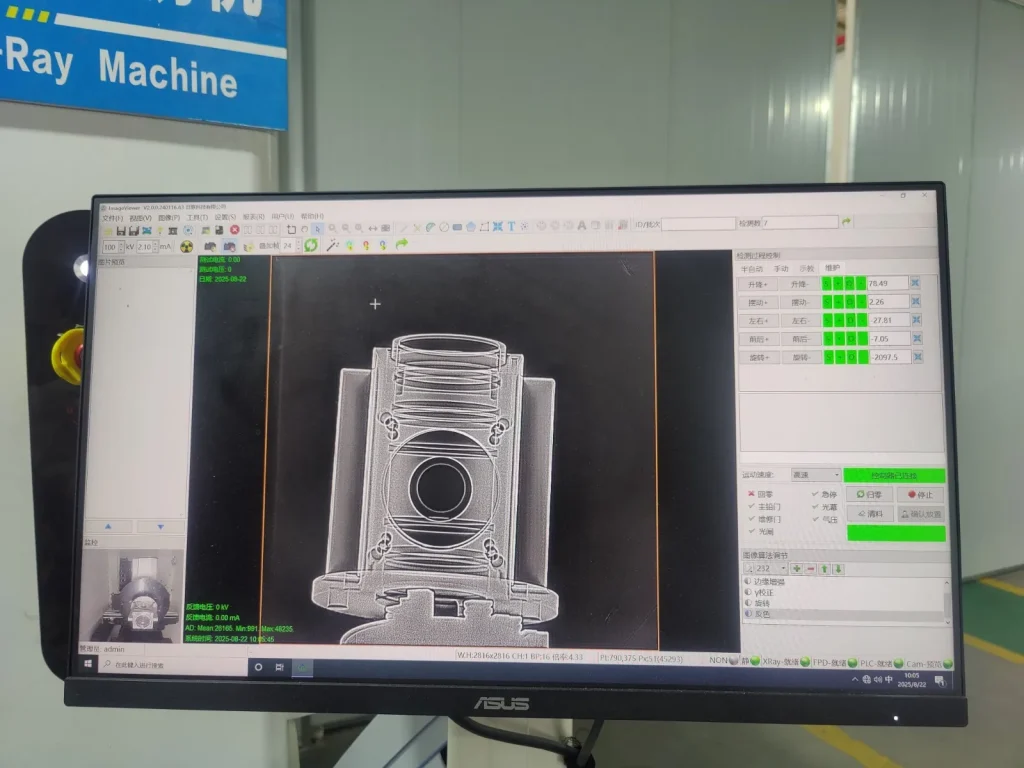
The criterion (pressure, medium, method, sweep time, limit), part identification, the result in units, and where any leak was located. A leak test proves only what it was set up to detect: it does not measure void content, which needs X-ray or CT, and it does not find a path that opens only under service load or heat.
Questions engineers ask
- What leak rate should I specify for a casting?
- Derive it from the medium, operating pressure and how much escape the product can tolerate over its life, then state method, test pressure, helium concentration, reject rate with units, stage and sampling. Do not copy a number from an unrelated part.
- Helium leak test or pressure decay?
- Pressure decay is fast and suits batch pass/fail to a maximum pressure drop, but does not locate the leak. Helium detects much smaller leaks and locates them; use it when the leak-rate requirement is tight.
- How do I convert leak rate units?
- 1 Pa·m³/s = 10 mbar·l/s; 1 mbar·l/s ≈ 0.987 atm·cc/s ≈ 59.2 sccm; 1 Torr·l/s ≈ 1.333 mbar·l/s.
- Does a helium leak test show porosity?
- No. It shows whether gas escapes through the wall under the test conditions. Void content needs X-ray or CT.
Send the part and the leak criterion
State the medium, test pressure, reject leak rate with units, and the stage. Howard Ding confirms how we will test it.
What happens next
- Howard Ding confirms receipt and asks for anything missing from the package.
- Engineering reviews geometry, alloy and acceptance criteria and proposes a route: squeeze casting, die casting, or a reason neither fits.
- You receive the quotation with tooling, samples and validation listed separately from the part price.