
Forging to casting conversion
A complex forging spends much of its cost in machining away the blank. A356-T6 squeeze casting can bring the part near net shape with T6 properties; the review decides whether it meets your load case.
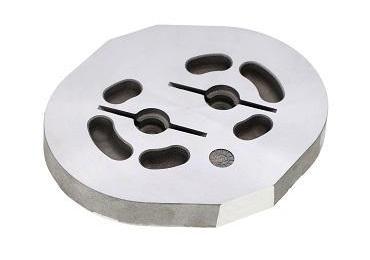
What the forging does well
Forging gives high strength through worked material, and for a compact part with simple geometry it is hard to beat. Its cost profile changes when the finished part is complex: draft and parting-line limits, shallow pockets, and the secondary machining needed to cut ribs, pockets and interfaces out of the forged blank.
A squeeze casting forms those features close to the finished geometry. Aluminum is poured at low velocity and solidified under pressure, typically 60 MPa and above in our process, then T6 heat treated and machined in-house. Whether that carries the load of the forged part is a validation question, not a datasheet one.
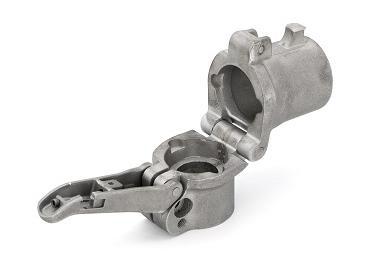
Forging to casting feasibility worksheet
Fill in each row for your part before asking for a quote. A row you cannot fill is the first question for the review.
| Check | What to compare | Evidence to agree |
|---|---|---|
| Property gap | Minimum properties of the forged material (e.g. 6061-T6) against A356-T6, at the stress-critical sections | The governing standards for both, and where test specimens are taken from the casting. Handbook values are not acceptance values. |
| Stiffness and fatigue | Section geometry, notches and the duty cycle | Component-level tests against the original load cases; one tensile result does not prove fatigue life |
| Machining removed | Operation list and cycle time on the forging vs the near-net casting | Both machining routes on the same finished drawing |
| Tooling payback | Casting die cost against machining time saved per part | Same annual quantity and release pattern in both quotations |
| Heat treatment and welding | Whether the part is welded or needs T6 | Alloy, temper and the weld procedure if any |
| Release | Drawing changes for draft, radii and datums | Approved drawing revision, sample sign-off, change control |
Material comparison: A356 / A356-T6 casting specification · Specifying mechanical properties
Is a casting cheaper than a forging?
Sometimes, and only on the finished part. The forging blank is often cheaper than the casting; the saving, when there is one, comes from the machining that the casting no longer needs and from the material that is no longer cut away. At low volume the forging usually stays cheaper because a casting die has to be paid for.
Put both routes on the same basis: tooling, material use, machining operations, heat treatment, inspection, scrap assumptions and annual demand.
Before you release a converted part, use our forging-to-squeeze-casting validation and acceptance checklist to plan first-article checks, mechanical-property sampling and the volume break-even review.
- Tooling: forging dies vs squeeze casting die
- Blank weight and material utilisation
- Machining operations and cycle time
- Heat treatment (T6) and straightening if any
- Inspection and test scope
- Scrap and yield assumptions, written into both quotes
When to keep the forging
Keep the forged part where validated performance, low demand, qualification cost or design constraints outweigh the manufacturing benefit. A forging that already passes its fatigue and durability programme is expensive to displace. Meeting one tensile target does not establish equivalent stiffness, fatigue behaviour or service life.
Published examples on this route
Electric scooter folding part, trailer connector, trailer bracket and boat part, all A356.2-T6. Material, condition and outcome for each are on the squeeze casting conversions page.
Questions engineers ask
- Can a forging be replaced by a casting?
- Often, when the forging is complex and heavily machined and the load case can be met by a T6 heat-treated squeeze casting. Compact, highly loaded parts usually stay forged. Validate on the actual component.
- Is a casting cheaper than a forging?
- Not per kilogram of blank, but often per finished part when the casting removes machining, scrap and assembly steps. Compare tooling, blank, machining, heat treatment and inspection at the same annual quantity.
- Is a squeeze casting as strong as a forging?
- A forged 6061-T6 part and an A356-T6 squeeze casting have different property profiles. Agree the required properties, the specimen location and the test method, then validate the casting on the real part.
Send the forging drawing
Include the forged alloy and temper, the load case or required properties, the machining drawing and the annual quantity.
What happens next
- Howard Ding confirms receipt and asks for anything missing from the package.
- Engineering reviews geometry, alloy and acceptance criteria and proposes a route: squeeze casting, die casting, or a reason neither fits.
- You receive the quotation with tooling, samples and validation listed separately from the part price.