
Leak-tested aluminum die castings
High-pressure die castings from 160 to 1,100 t, machined and leak tested in our own plant. For housings that must hold an agreed leak criterion at volume, and an honest answer when the part should be squeeze cast instead.
Send drawing for DFM review Squeeze vs die casting worksheet
When is a die casting pressure-tight enough?
High-pressure die casting fills the die at high speed. That is why it is the economical route for complex, thin-walled parts at volume, and also why it traps gas. Porosity is a characteristic of the process, so a die casting can be pressure-tight only when the leak test, the porosity regions and the machining are agreed for the part.
It is usually enough when every row on the right holds. If one does not, compare squeeze casting before the tool is cut.
- Walls are thin and the volume is high
- No T6 heat treatment and no welding on the casting
- The leak criterion is stated: medium, pressure, leak rate, stage
- Machined sealing faces do not cut deep into thick sections
- X-ray regions and limits are agreed where porosity would open after machining
- Whether impregnation is allowed is written on the drawing
Design the casting and the finished part together
Identify the surfaces that must be machined, the datums and the finished dimensions. Parting line, draft, wall transitions, ejection and machining allowance are reviewed before tooling, with the leak path in mind.
| Topic | What we review | Why it matters for a sealed part |
|---|---|---|
| Geometry | Wall sections, ribs, bosses, draft and parting line | Heavy sections next to sealing faces are where shrinkage and gas porosity collect |
| Alloy | Material specification and required final properties | Die casting covers ADC, A3xx and AlSi grades; T6 is not planned on a conventional die casting |
| Machining | Datums, bores, threads and sealing faces | Machining stock decides how deep a cut goes into the casting skin |
| Quality | Inspection criteria for the casting and the finished part | Leak test and X-ray acceptance are written per region, not for the whole part |
Leak testing on die-cast housings
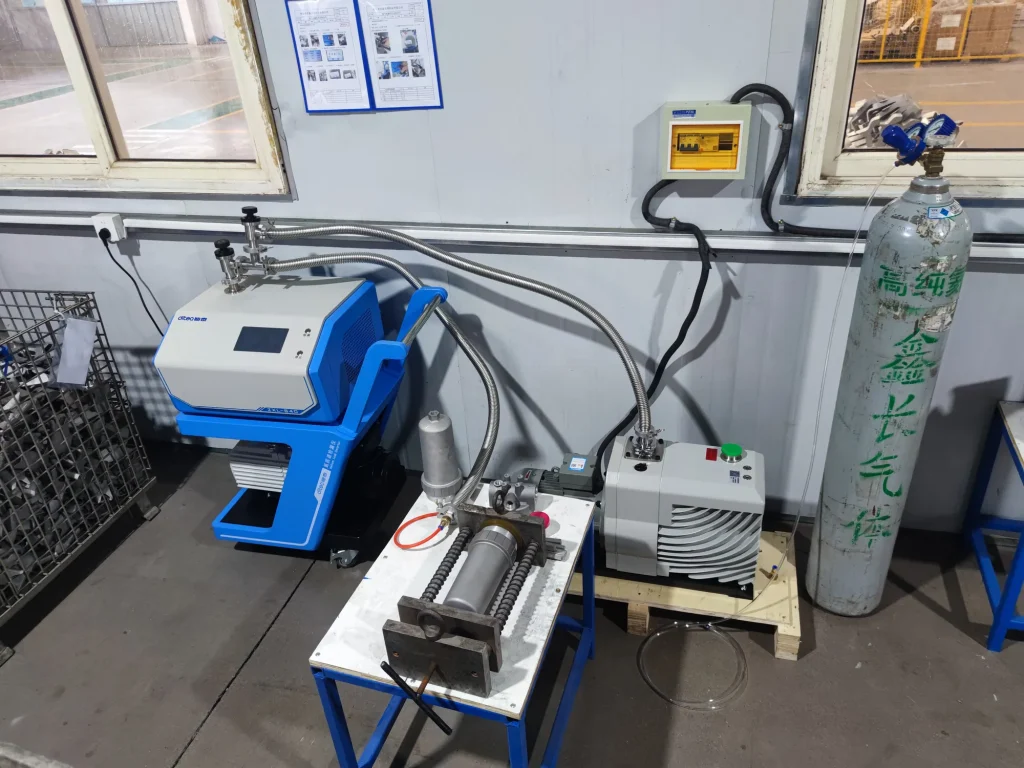
We run water immersion (bubble) testing and helium leak testing with a sniffer in-house, and pressure testing to an agreed value where a pressure figure is the requirement. The method is chosen by the leak rate the part needs, not by habit: over-specifying it costs money on every part, under-specifying it certifies nothing.
Test at the stage that matters. If machining crosses the pressure boundary, the leak test belongs after machining.
| Method | Best fit |
|---|---|
| Water immersion | Volume checks with a coarse leak criterion; shows where the leak is |
| Helium, sniffer | Tight leak-rate requirements below the visible-bubble threshold; locates the leak |
| Pressure testing | A stated pressure the part must hold; a strength check, kept apart from the leak rate |
Die casting tolerances: by feature, not by process
Two bores on the same casting can carry different tolerances and still be produced economically, as long as each is specified for what it does. Features formed in one die half are held to the tolerances agreed for the tool; dimensions that cross the parting line or depend on a slide vary more and are reviewed before they are fixed.
Where a requirement is tighter than the casting can hold, stock is left on the feature and it is machined to size.
- Datum scheme matches how the part is inspected and assembled
- As-cast and machined features listed with a tolerance for each
- Dimensions on a slide or across the parting line flagged
- Functional flatness, parallelism and concentricity marked as such
What drives the price of a leak-tested die casting
Separate the parts of the quotation and two offers that look different can be compared on the same scope. A lower part price that leaves out machining, heat treatment or testing is a price for less work.
| Cost element | What sets it |
|---|---|
| Tooling | One-time; part geometry, number of slides, parting line, tool steel and expected life |
| Casting | Part weight, machine size, cycle time set by wall thickness and cooling; metal on a stated price basis |
| Secondary operations | Machining, deburring, finishing, leak testing and inspection, each listed separately |
| Volume and releases | Annual quantity and release pattern; scheduled releases cost less per part than repeated small orders |
| Scrap and yield | The leak and X-ray acceptance you specify; state the assumption in every quotation you compare |
When we will quote squeeze casting instead
If the part must be T6 heat treated or welded, has a tight defect budget at a machined sealing face, or keeps failing leak test as a die casting, we say so and quote A356-T6 squeeze casting on 300–1,100 t presses. The comparison uses the same drawing, quantity and acceptance criteria.
Questions engineers ask
- When is a die casting pressure-tight enough?
- When the leak criterion is achievable with the wall sections, gating and machining stock of the part, and a sample lot passes the agreed test after machining. Thick sections at machined sealing faces and T6 requirements are the usual reasons a die casting is not enough.
- Which leak tests do you run on die castings?
- Water immersion (bubble) and helium sniffer testing in-house, and pressure testing to an agreed value. Medium, pressure, leak rate, stage and sampling are agreed per part.
- Why do die castings fail leak test after machining?
- Machining opens internal gas porosity and shrinkage near the surface. A connected chain of pores, cold shuts and micro-shrinkage forms a leak path that was invisible in the as-cast part.
- Can a leaking die casting be impregnated?
- Vacuum resin impregnation can seal micro-leakage, but only where the drawing permits it and with reinspection. On a pressure boundary it must be agreed in advance.
Send a drawing for a route review
Send a 2D drawing and, if available, a 3D model with the alloy, annual quantity, critical tolerances and any pressure or leak requirement. Howard Ding replies with the proposed route, open questions and the tests that apply.
What happens next
- Howard Ding confirms receipt and asks for anything missing from the package.
- Engineering reviews geometry, alloy and acceptance criteria and proposes a route: squeeze casting, die casting, or a reason neither fits.
- You receive the quotation with tooling, samples and validation listed separately from the part price.