
Automotive structural aluminum castings
Brackets, mounts, beams and housings for automotive and trailer assemblies, squeeze cast in A356.2-T6 where strength, heat treatment or welding is required, under IATF 16949:2016.
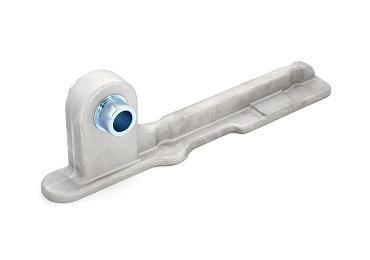
Start from the part's job in the assembly
A bracket, a housing and a fluid-carrying part need different validation. Bring the load directions, the fastening interfaces and the approval level your customer requires; the casting route follows from them.
| Part type | Requirements to provide | Engineering review |
|---|---|---|
| Mounts and brackets | Load directions, cyclic duty, fastening interfaces, dimensional stability | Static and durability tests defined with your product engineer; a coupon result does not replace component validation |
| Structural beams and arms | Load case, stiffness, weld locations, properties by section | A356-T6 squeeze casting evaluated where T6 and welding are needed; properties agreed per section and specimen location |
| Motor and transmission housings | Bearing seats, coaxial features, mounting datums, seal interfaces | Machining datums and assembled fit; leak checks after machining |
| Customer documentation | Submission level, material records, traceability, change control | Named in the RFQ and confirmed with the quotation |
Why structural parts go to squeeze casting
Squeeze casting fills at low velocity and solidifies under pressure, so the part can be T6 heat treated and welded, which a conventional die casting usually cannot. Our published structural examples are in A356.2-T6: a trailer bracket that replaced a sand casting and is weldable, a trailer connector that replaced a steel casting (see aluminum vs steel trailer castings), and a one-piece trailer beam. We also run an engine mount bracket in A383 as a squeeze casting.
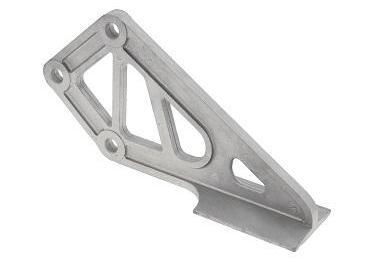
PPAP and certified scope
We hold IATF 16949:2016 (certificate 0494978, scope: manufacturing of aluminium alloy die-cast parts; clause 8.3 product design excluded). Design authority stays with you. Name the PPAP submission level and the customer-specific requirements in the RFQ so scope and responsibilities are agreed before tooling.
- Drawing and model with revision, material specification and condition
- Initial and annual quantities and target sample date
- Load case, weld locations and properties by section
- Submission level and customer-specific requirements
- Mandatory acceptance criteria separated from preferences
Questions about automotive castings
- Are you IATF 16949 certified?
- Yes: IATF 16949:2016, certificate 0494978, scope manufacturing of aluminium alloy die-cast parts, with clause 8.3 product design excluded. Design authority stays with the customer.
- Can squeeze-cast parts be welded and heat treated?
- Yes. Squeeze casting solidifies under pressure, so A356-T6 parts can be heat treated and welded. Our published trailer bracket in A356.2-T6 is weldable. Weld locations and properties by section are agreed on the drawing.
- Do you supply PPAP?
- Name the submission level and customer-specific requirements in the RFQ. The PPAP scope and responsibilities are agreed with the quotation, before tooling.
Send the part, the load case and the PPAP level
Attach the drawing, weld locations and properties by section. Howard Ding replies with the route and the documentation scope.
What happens next
- Howard Ding confirms receipt and asks for anything missing from the package.
- Engineering reviews geometry, alloy and acceptance criteria and proposes a route: squeeze casting, die casting, or a reason neither fits.
- You receive the quotation with tooling, samples and validation listed separately from the part price.