
Squeeze casting conversions
Send the part you make today, forged, die cast, gravity cast, machined from billet or in steel. We review whether A356-T6 squeeze casting can meet the same drawing, and say so when the current route should stay.
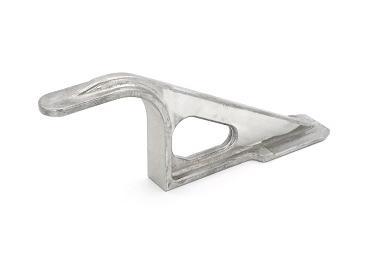
Why a conversion is reviewed
A part is rarely reviewed because somebody prefers a different process. It is reviewed because something on the finished-part route is not working: a leak, a void that appears after machining, a mechanical test failed repeatedly, a weight target that cannot be met, or a machining step that costs more than the forming step before it.
That decides whether a conversion is worth pursuing. If the current process is not the cause, replacing it adds tooling and qualification cost without removing the defect. So the review starts with the failure mode, not with the process.
- A documented "no" is a result
- If the existing route is the better answer, you get the reason and the useful part of the review, not a quotation.
- Finished part against finished part
- Tooling, machining, heat treatment, inspection and scrap on the same quantity. Casting price against casting price is not a conversion case.
Squeeze casting conversions by original route
The routes reviewed most often. Each page sets out what the review has to establish and when keeping the existing process is the better decision.
| Original route | What usually prompts the review | Where squeeze casting is evaluated | Guide |
|---|---|---|---|
| Aluminum forging | Pockets, ribs and interfaces that need heavy secondary machining | When a casting can form those features closer to the finished geometry | Forging to casting |
| High-pressure die casting | Gas porosity limits T6, welding and pressure tightness | When a leak, a void exposed by machining or a failed test cannot be solved on the existing route | HPDC porosity to squeeze |
| Gravity, sand or low-pressure casting | Shrinkage rejects; sections heavier than the function needs | When internal soundness or wall thickness is the reason for the review | Gravity and LPDC to squeeze |
| Machining from billet | Above a certain volume most of the material becomes chips | When volume justifies tooling and only functional faces still need machining | Billet to casting |
| Steel or iron casting | A part that weighs more than the load path needs | When weight matters and sections and fasteners can be redesigned | Steel to aluminum, below |
Conversion feasibility checklist
Every review answers the same five questions before a die is designed.
| Question | What has to be agreed |
|---|---|
| What is the finished part for? | Load cases, interfaces, environment and durability, taken from the function, not from the current process |
| Which property is the constraint? | Internal soundness, heat treatment, weldability, weight or machining time; the one that decides the application is the one the conversion must solve |
| What has to be re-validated? | Sample location, test methods, component checks and acceptance limits, agreed before the first trial |
| What does the finished part cost? | Tooling, cycle time, material use, machining, heat treatment, inspection and scrap on the same quantity and inspection basis |
| What if the review says no? | A documented reason. Keeping a process that works beats changing one that is not the cause |
How a conversion review runs
Assess and cost
Current drawing, alloy, condition and process sequence reviewed against the requirement. Proposed geometry, alloy and heat treatment, with a finished-part cost comparison.
Tool and sample
Die design, process parameters and the sample plan. Samples are cast, T6 treated and machined in-house against the agreed specification.
Validate and release
The agreed dimensional, material, mechanical, X-ray or leak tests on the samples; then the approved drawing revision, sample sign-off, change control and production inspection plan.
Steel or iron casting to aluminum squeeze casting
Steel and iron castings bring stiffness, wear resistance and predictable cost, at roughly three times the density of aluminum. Where the part moves, its weight becomes a cost in payload, fuel, handling and in the loads the surrounding structure has to carry.
It is a design change, not a material swap. A 1:1 steel section in aluminum will not behave the same way: sections usually get deeper or differently ribbed to match bending stiffness. The published trailer connector, A356.2-T6 squeeze cast, replaced a steel casting with at least 54% weight reduction reported, and it was a redesign. For the weight savings and design changes involved, see our trailer casting comparison.
Keep the steel or iron casting where stiffness, wear, impact or thermal duty dominate, or where the surrounding structure and fasteners cannot change.
| Review stage | Required comparison |
|---|---|
| Stiffness, not only strength | Aluminum has a lower elastic modulus; check bending stiffness of the new section |
| Fasteners and interfaces | Bolt bearing, thread engagement and galvanic isolation change with the parent material |
| Fatigue and service | Duty cycle, temperature and corrosion re-checked for the aluminum design |
| Component validation | Tests on the finished part against the original function |
Published conversion examples
Outcomes are the published results of the original projects, not a forecast for another part. Your business case is built from your own drawing, volume and validation requirements.
| Part | Material / condition | Original route | Published outcome |
|---|---|---|---|
| Electric scooter folding part | A356.2 / T6 | Forged / machined | Cast closer to finished geometry; at least 40% cost saving reported |
| Trailer connector | A356.2 / T6 | Steel casting | At least 54% weight reduction reported |
| Trailer bracket | A356.2 / T6 | Sand casting | Weldable; about 50% higher strength reported |
| Tent folding part | A356.2 / T6 | High-pressure die casting | About 50% higher strength reported |
| Boat part | A356.2 / T6 | High-pressure die casting | At least 50% higher strength reported |
| Trailer beam | A356.2 / T6 | Steel | Produced as one casting; substantial weight reduction reported |
Case studies A356-T6 squeeze casting
Questions engineers ask
- Which parts are good candidates for squeeze casting conversion?
- Parts with 4–15 mm walls that need internal integrity, T6 heat treatment, weldability or pressure tightness, and that are forged, machined from solid or rejected for porosity today.
- Can a steel part be converted to aluminum squeeze casting?
- Sometimes, where the loads allow an aluminum section. Published examples show weight reductions of about 50% or more on trailer and boat parts; each part needs a load and stiffness review on its own drawing.
- What does a conversion review cost?
- The drawing review is part of quoting. Send the drawing and the current route; Howard Ding replies with the feasibility questions or the quotation.
- When should the current process stay?
- When the part is compact and simple enough that forging or billet machining is already economical, when volumes are too low to pay for a tool, or when the geometry falls outside the squeeze casting window.
Send a part you want to convert
Send the drawing, the current process and alloy, the annual quantity and why you are reviewing it: cost, leaks, weight or lead time.
What happens next
- Howard Ding confirms receipt and asks for anything missing from the package.
- Engineering reviews geometry, alloy and acceptance criteria and proposes a route: squeeze casting, die casting, or a reason neither fits.
- You receive the quotation with tooling, samples and validation listed separately from the part price.