
Die castings failing leak test: HPDC porosity to squeeze casting
If a die casting keeps failing leak test after machining, the porosity is often built into the process. We run both die casting and squeeze casting, so the review compares a die-casting fix with a squeeze-casting sample on the same drawing.
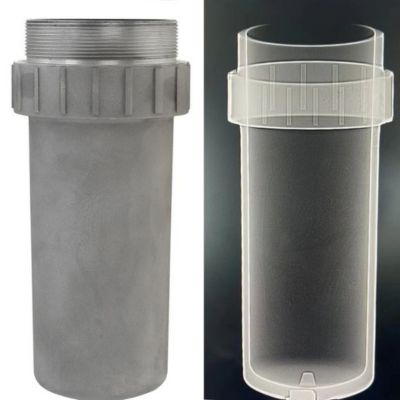
Why die castings fail leak test
High-pressure die casting fills the die at high speed and traps gas. Most of that porosity is harmless until a machining cut opens it at a sealing face, or until a pressure test connects several pores, a cold shut and a micro-shrinkage void into a path through the wall. The same trapped gas expands during solution heat treatment, which is why conventional die castings blister when someone tries to T6 them.
Squeeze casting fills at low velocity and holds the metal under pressure while it solidifies, so there is less gas to trap and less shrinkage to connect. It is worth the change only when the rejection mode cannot be fixed on the existing route.
Decision path for a part that is already failing
Work down the rows in order. Most leaking die castings are fixed in the first three; the conversion case starts where they stop.
| Symptom | Check first | Options on the existing route | When to evaluate squeeze casting |
|---|---|---|---|
| Leak at a machined sealing face | Leak location, machining stock and cut depth, X-ray of that region | Less machining stock, gating or overflow change, local cooling | Thick section under the sealing face that keeps opening porosity |
| Slow, intermittent leaks | Venting and overflow, die temperature stability | Vent and overflow redesign, process window held tighter | Defect budget too small for any die-cast process window |
| Blisters after heat treatment | Whether T6 is really required | Drop to as-cast or a lower temper if the design allows | T6 or welding is required on the casting |
| Failed tensile or elongation test | Specimen location and the property requirement | Alloy or specimen location review | The requirement needs heat-treated A356-T6 properties |
| Leaks fixed only by impregnation | Whether impregnation is allowed on the drawing | Impregnation with agreed reinspection | Impregnation not allowed, or not acceptable for the medium |
What the conversion review must establish
| Review stage | Required comparison |
|---|---|
| The actual failure mode | A leak, a void exposed after machining, or a failed mechanical test, with location and test conditions |
| Acceptance held constant | The same inspection method and limits applied to samples from both routes |
| Heat treatment and welding | Whether T6 or welding is required; that is often what rules out the die casting |
| Cost of the change | Tooling, cycle time, machining allowance, yield and scrap |
| Volume | Squeeze casting has a different economic window from die casting at very high volume |
When to keep the die casting
Keep die casting for thin walls, fine detail, high volume and cosmetic parts where internal soundness has never been the problem. A part that passes leak test after a gating fix does not need a new process.
Published examples on this route
Tent folding part and boat part, both A356.2-T6 squeeze cast to replace high-pressure die castings, with about 50% and at least 50% higher strength reported.
Questions engineers ask
- Why do die castings fail leak test?
- High-speed injection traps air and gas; with shrinkage at thick sections this forms porosity. Machining opens it, and connected pores become a leak path. Blisters after heat treatment come from the same trapped gas.
- Should I fix the die casting or switch to squeeze casting?
- Check gating, venting and parameters first; impregnation may be acceptable where the drawing allows it. If the part needs T6, has thick machined sealing faces or keeps failing, sample squeeze casting on the same drawing.
- Does squeeze casting eliminate porosity?
- It suppresses shrinkage and gas porosity by solidifying under pressure, but no process guarantees zero porosity. Keep the leak test and the X-ray criteria.
Send the leaking part
Include the drawing, the leak test (medium, pressure, limit), where it leaks and the reject rate you see.
What happens next
- Howard Ding confirms receipt and asks for anything missing from the package.
- Engineering reviews geometry, alloy and acceptance criteria and proposes a route: squeeze casting, die casting, or a reason neither fits.
- You receive the quotation with tooling, samples and validation listed separately from the part price.