

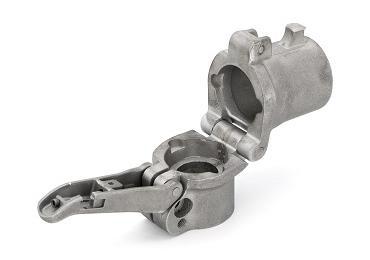
CEX’s published example describes an A356.2 folding component with T6 heat treatment, evaluated as an alternative to a forged part. A new conversion needs its own drawing review, component validation and finished-part cost comparison.
Published application: a folding component
| Item | Published information |
|---|---|
| Component | Folding part |
| Material | A356.2 |
| Heat treatment | T6 |
| Conversion objective | Reduce secondary machining while meeting the component requirements |
The original article reports machining savings and mechanical test values. The underlying cost records, test reports and specimen details are not included in this website edition, so those figures are not presented here as independently verified results or as a forecast for another component.
Why assess a change?
An existing forged component may need substantial machining to create pockets, ribs or interfaces. A casting-based route can be investigated when those features could be formed closer to the finished geometry. The business case depends on the redesigned part, tooling, volume and approved performance, rather than the process name alone.
What a conversion review must establish
| Review stage | Required comparison |
|---|---|
| Functional specification | Same load cases, interfaces, environment and durability requirements |
| Material and design | Approved alloy and heat treatment; review of section geometry and stress-critical features |
| Validation | Sample location, test methods, component checks and acceptance limits |
| Economics | Tooling, machining time, heat treatment, inspection, scrap assumptions and demand |
| Release | Approved drawing revision, sample sign-off and change-control requirements |
When retaining forging may be appropriate
Keep the existing process in the comparison where validated performance, low demand, qualification cost or design constraints outweigh the potential manufacturing benefit. Meeting one tensile-strength target does not establish equivalent stiffness, fatigue behavior or service life.
Bring an existing part to the review
Supply the current drawing, alloy and condition, production quantity and machining sequence. Describe the reason for considering a change and the validation that a replacement must pass. Share cost information only where you are authorized to do so.