

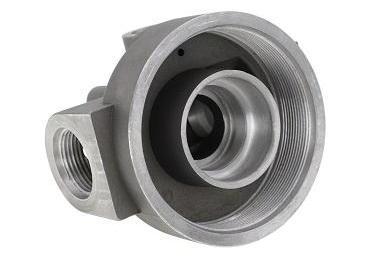
A fluid-control casting needs a defined pressure boundary and a measurable leak requirement. Include the medium, operating conditions, sealing arrangement and finished machining state in the RFQ.
Castings for pressure and sealing requirements
| Application focus | Requirements to provide | Engineering review |
|---|---|---|
| Pump and valve bodies | Internal passages, media exposure and threaded ports | Mark pressure-containing regions and machined surfaces that may intersect internal discontinuities. |
| Sealing interfaces | Seal type, surface finish, flatness and assembly condition | Specify the mating seal and whether the component is tested alone or as an assembly. |
| Leak and pressure testing | Test medium, pressure, allowable leak rate, dwell time and sampling | Keep strength or proof-pressure testing distinct from leak testing; agree both where the application requires them. |
Plan around the complete assembly
Review the casting route before tooling when leakage is the main concern. CEX lists X-ray inspection and helium leak detection capabilities, but availability does not define an acceptance method. Agree the test fixture, conditions, records and stage of manufacture.
Build the manufacturing route
Review die casting against the geometry and demand. Where heat treatment or internal integrity drives the decision, compare squeeze casting. Identify finished features for CNC machining and agree the final inspection condition.
Prepare an application-specific RFQ
Send the drawing and model, material specification, initial and annual quantities, and the operating requirements above. Identify open questions and distinguish mandatory acceptance criteria from preferred features. Include target sample and production dates so approval steps can be planned.
Common application questions
Is an X-ray result enough to prove leak tightness?
No. An internal-integrity inspection and a leak test evaluate different characteristics. Define the leak acceptance and any internal-discontinuity limits separately.
When should the leak test take place?
Specify the delivered condition. If machining or assembly can affect the pressure boundary, include the appropriate check at that stage in the agreed inspection plan.